2026-10-28
Folk Riddles is a free riddle game for kids and families: read the clue, pick the picture and word, and learn a new English word with 20+ levels, stars and short explanations, right in your browser.
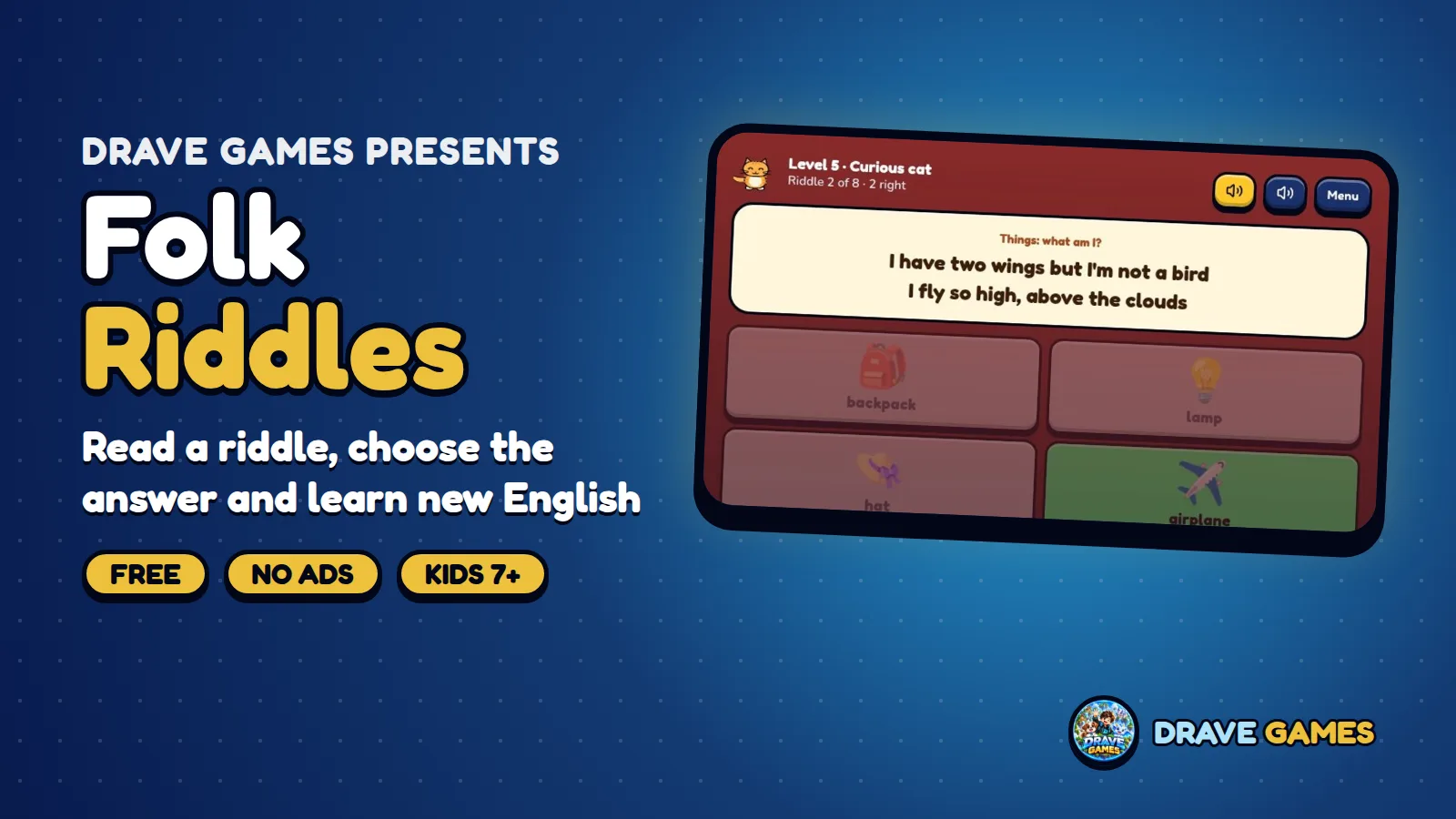
Folk Riddles is a friendly riddle game that helps children practise English while they think. Read or listen to the clue, tap the picture and word that fit best, and the game explains the answer. It is free, runs in your browser on a phone, tablet or computer, and needs no account or download.
Riddles are one of the oldest ways to play with words, and this game brings them to the screen. Every question, answer and explanation in this edition is in English, so each riddle is also a short English reading and vocabulary exercise. The clues are written for this game.
There are more than 20 levels. Each level brings trickier riddles and more answers to choose from, and later levels take the pictures away so children rely on the words alone. This gentle climb keeps beginners encouraged and gives confident readers a challenge.
Children learning English at home or school, and families who enjoy word games together. A grown-up can read the riddles aloud for younger players. It is free, with no sign-up, no chat, no ads and no purchases. Play from the Folk Riddles page.
Is Folk Riddles free? Yes.
Is it only in English? This edition is in English. A Vietnamese version exists as Đố Vui Dân Gian.
How many levels are there? More than 20.
Does it work on phones? Yes, on phones, tablets and computers.
Is it safe for kids? No sign-up, no chat, no ads, no purchases.
Play the first level together and read each riddle aloud. Ask your child to say *why* they chose an answer before they tap it; explaining a choice is excellent speaking practice. When the explanation appears after each answer, read it together and use the new word in a sentence, for example "I can see a rabbit in the garden."
For classrooms, the game suits a five-minute warm-up or a station in a vocabulary rotation. Because progress and stars stay on the device, there is nothing to set up for students and no data to manage.
A riddle gives a context, a clue and a surprise, and all three help memory. Children meet a new word as the answer to a puzzle rather than as an item on a list, so the word comes with a picture and a reason. The later levels remove the pictures, which gently moves children from guessing by image to reading with understanding.
Suppose the clue says: *"I have four legs but I cannot walk, and you sit on me at dinner."* The game shows several pictures with words, and the child chooses the one that fits. After the choice, a short explanation says why the answer is right and which word to remember. A wrong answer is met with a kind explanation, not a penalty, so children are happy to try again.
The first levels use pictures, so they are good for beginners and for younger children. In the middle levels the answers become more similar and the clues use more words. In the late levels the pictures disappear and the child must read carefully. Aim for three stars on a level before moving on; replaying is quick and builds confidence.
Try Lingo Pals for languages and World Kitchen for cooking fun. Browse the Games section and Updates.
#DraveGames #FolkRiddles #Riddles #LearnEnglish #Vocabulary #Quiz #Education #KidsGames #FreeGames